Entry of
How to block a hand-knit sweater
Blocking is the step that turns a knitted object into a garment. It is also the step most often skipped, and the one that most changes the result.
A sweater straight off the needles is uneven, slightly the wrong size and a little stiff. Blocking is what fixes all three, and on wool it is close to magic. On other fibers it does less, or something quite different, and knowing which is which prevents an expensive accident.
What blocking actually does
Wool is a protein fiber. Water breaks the weak bonds that hold each fiber in its current shape, the fabric relaxes, and as it dries the bonds reform in whatever shape it has been left in. The stitches even out, the fabric grows into its intended measurements, and it stays there until the next wash resets it.
- Wet blocking
- Soaking the piece, removing the water and drying it flat in shape. The most thorough method, and the right one for wool.
- Steam blocking
- Holding a steam iron above the fabric without touching it. Faster, less thorough, and the only method that affects synthetics.
- Spray blocking
- Pinning the dry piece out and misting it with water. Useful for small adjustments and for pieces that must not be handled wet.
Wet blocking, step by step
- Fill a basin with lukewarm water and add a little wool wash. Keep the temperature the same throughout: sudden changes plus movement are what felts wool, not water itself.
- Lay the sweater on the surface and let it sink on its own. Leave it 15 to 20 minutes. Do not stir, rub or wring it at any point.
- Lift it out supported from underneath with both hands, so it does not hang and stretch under the weight of its own water.
- Press the water out against the side of the basin, then roll the sweater in a dry towel and press down on the roll, or stand on it.
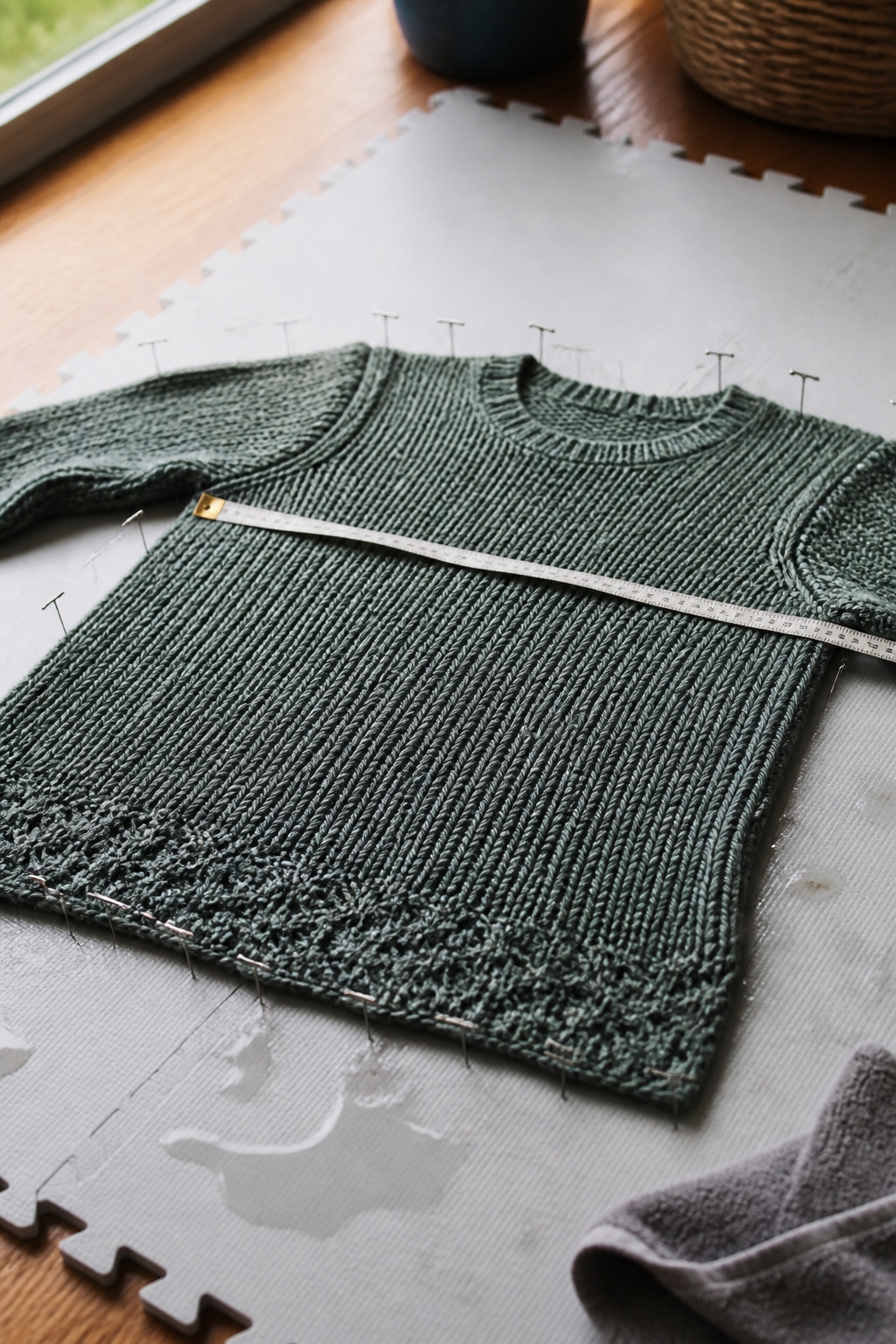
- Lay it flat on blocking mats, or on towels on a spare bed, right side up.
- Pat and pin it to the measurements on the schematic: chest, body length, sleeve length, cuff width, shoulder to shoulder. Measure with a tape. Do not eyeball it.
- Dry flat, away from direct sun and away from radiators, for 24 to 48 hours. A fan pointed at it roughly halves the time.
How much to pin, and where not to
- Ribbing: leave it relaxed. Pinning ribbing flat destroys the elasticity that makes it work, and a stretched hem never pulls in again.
- Cables: do not stretch them sideways. Cables get their depth from being pulled in; flattening them flattens the pattern.
- Lace: the opposite. Lace needs to be opened firmly, and blocking wires threaded along an edge give a straight line that pins alone cannot.
- Everything else: block to the schematic, not beyond it. Going two inches larger because the fabric allows it produces a sweater two inches too large.
Superwash, alpaca and other growers
Superwash wool has had its scales removed or coated so that it can go in a machine. It also loses some of its memory: superwash fabric relaxes further in water and keeps the extra length. Block it to the measurement, never beyond, and dry it flat.
Alpaca, silk and cotton all grow lengthwise under their own weight when wet, and cotton does not really spring back at all. For those fibers, plan the length before knitting, block gently, and check the length again after the first wash.
The rule that follows from all of this: never hang a wet knitted garment. A wet sweater on a hanger will lengthen by inches at the shoulders, and those inches do not come back.
Acrylic: water does nothing, heat does everything
Acrylic is a thermoplastic. Soaking it changes nothing at all, because there are no bonds for water to break and reform. Only heat alters it, and heat alters it permanently.
Steam held a few centimetres above the fabric will relax a curling edge and flatten a stiff panel. Knitters call this killing the acrylic, and the name is accurate: the loft goes out of the fabric and it drapes limply from then on. It is sometimes done deliberately, to make a stiff acrylic behave like something softer, but there is no way back.
So: test on a swatch first, never let the iron touch the fabric, and prefer to knit acrylic to its final measurements rather than plan on stretching it. The fiber comparison in the entry on reading a yarn label sets out which fibers respond to water and which do not.
| Fiber | In water | With steam | Drying |
|---|---|---|---|
| Wool | Relaxes and holds the new shape until the next wash | Works, quicker, less thorough | Flat, 24 to 48 hours |
| Superwash wool | Relaxes further and grows; block to size, not beyond | Works | Flat, never hanging |
| Cotton | Little change, grows lengthwise under its own weight | Works well, flattens the fabric | Flat, slow |
| Alpaca and silk | Relaxes a great deal and lengthens | Works | Flat, check the length |
| Acrylic | No effect | Permanent: relaxes, loses loft | Any, it does not matter |
Pieces or finished garment
A sweater knitted in pieces and seamed should be blocked before seaming. Flat edges are far easier to sew, the measurements can still be corrected, and the seams themselves then need only a light press. A seamless yoke sweater is blocked once, finished, with the sleeves laid straight and the yoke patted into a circle.
Afterwards
Store knitwear folded, never on a hanger. Air it rather than washing it: most sweaters need washing far less often than they get it. When it is washed, block it again, because the garment returns to the shape it was last dried in, every single time.