Entry of
How to fix a dropped stitch, one rung at a time
A dropped stitch is not a hole. It is a loop that has let go of the loop above it, and the fabric keeps an exact record of how far it fell.
Knitted fabric is one continuous strand pulled through itself. Nothing in it is knotted, and no loop is fastened to anything except the loop above it. That is the whole reason a stitch can run down the fabric, and also the reason it can be put back.
First, stop the run
Before looking at anything, put something through the loose loop: a locking stitch marker, a safety pin, a spare needle, a bent paper clip. A secured stitch can wait a week. An unsecured one falls another row every time the knitting is picked up or set down.
Then put the work flat on a table in good light, with the knit side facing you. Almost every repair is easier from the smooth side.
Read the ladder
Under the loose loop you will see short horizontal strands stacked one above another. Each strand is one row that the stitch has fallen through. Count them: that number is how many moves the repair takes.
- Dropped stitch
- A live loop that has slipped off the needle without being worked.
- Ladder
- The row of loose horizontal strands left behind by a stitch that has fallen. One rung per row.
- Run
- The continuing fall of a dropped stitch down through the fabric, one row at a time.
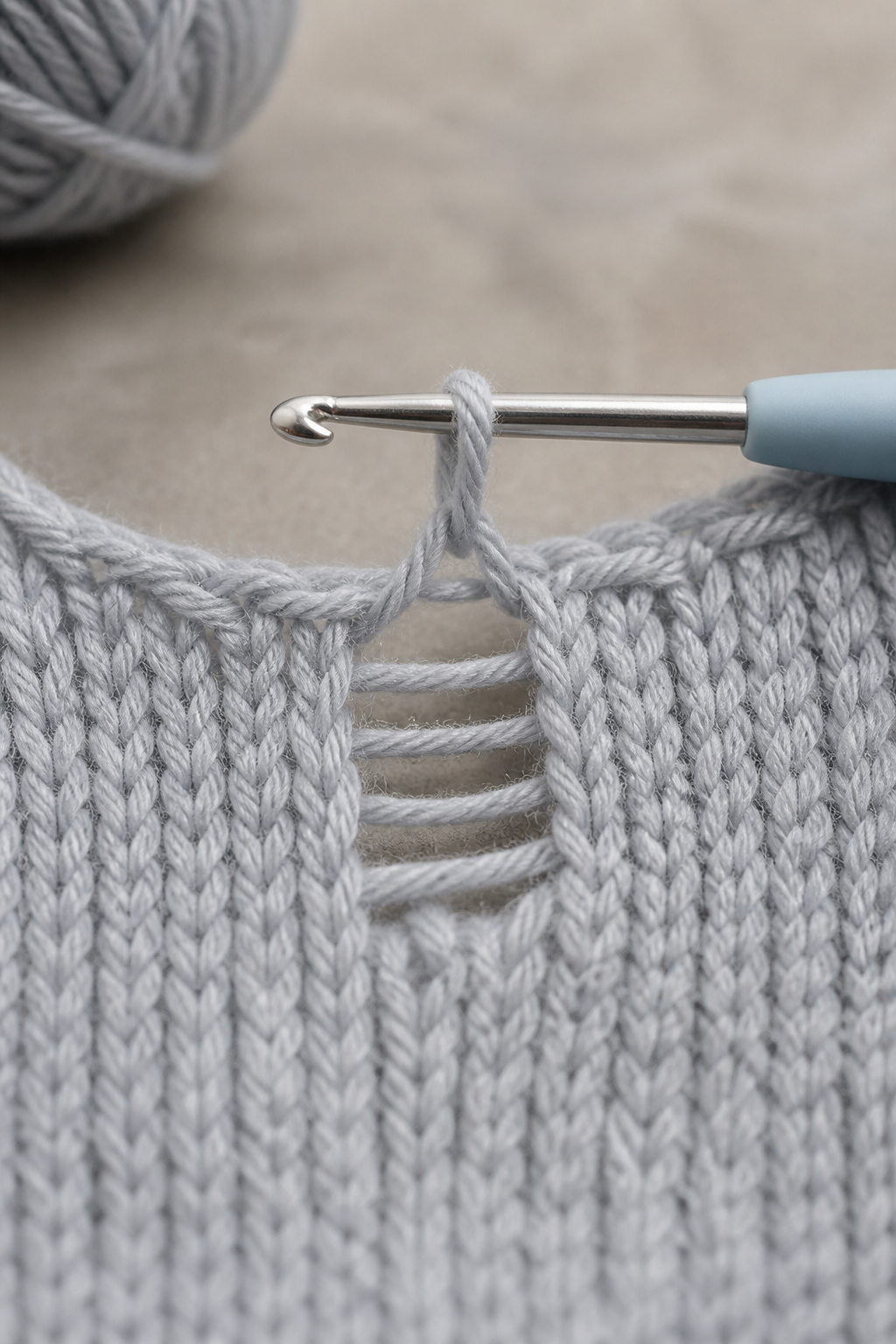
The stockinette repair
Use a crochet hook a little smaller than the knitting needle. A hook that matches the needle exactly is hard to pull through a tight stitch.
- With the knit side facing you, push the hook through the loose loop from front to back.
- Catch the lowest rung of the ladder, the one nearest the loop.
- Pull that rung through the loop. The old loop slides off the hook; the rung is now the new loop, sitting on the hook.
- Repeat with the next rung up, and the next, until the ladder is used up.
- Move the last loop onto the left needle, checking that it is not twisted: the right leg of the loop sits in front of the needle.
On the purl side
A purl stitch is a knit stitch seen from behind, so there is no separate purl repair. Turn the work so the knit face is toward you and work as above. When the fabric cannot be turned, for instance in the middle of a round, insert the hook from the back and push each rung toward you instead of pulling it away.
Garter stitch: turn the work at every rung
Garter stitch alternates knit rows and purl rows on the same face, so consecutive rungs face opposite ways. Pick up one rung with the knit side toward you, turn the work, pick up the next, turn again. It is slower and the movement never changes.
Ribbing, cables and lace
In ribbing, follow the column the stitch belongs to: knit columns are picked up from the front, purl columns from the back, which in practice means turning the work for those columns exactly as in garter stitch.
A stitch that has fallen through a cable crossing or a yarn over cannot be rebuilt column by column, because the strands no longer run straight up. Take the work back to a row below the damage instead. That is the argument for a lifeline: a length of smooth waste yarn threaded through every stitch of a complete row, every ten or twenty rows, in any pattern with crossings or holes. Ripping back to a lifeline is a two minute job.
When the repaired column looks loose
A rebuilt column often sits baggy, because the yarn was borrowed from its neighbours while the stitch hung free. Tug gently along the row in both directions to spread the slack over several stitches, then leave it. Wool evens out almost completely after a soak and a flat dry; cotton and acrylic even out much less, so on those fibers it is worth taking more care while the stitches are still on the hook.
Not every loose stitch is dropped
Two lookalikes are worth telling apart. A twisted stitch sits on the needle the wrong way round, with its left leg in front; it has not fallen, it was mounted backwards, and knitting into the back of it puts it right. An accidental yarn over is an extra loop created when the working yarn passed over the needle before a knit stitch; it makes a small hole and one stitch too many. Drop it deliberately off the needle and let it go, then check the stitch count.
Avoiding the next one
- Push the stitches back from the needle tips before putting the work down.
- Use point protectors, or park the work mid-row rather than at the very end of a needle.
- Count the stitches at the end of every row for the first weeks. A count that changes tells you which row to check.
- Run a lifeline through complicated sections before you get tired.
Dropped stitches are not a beginner problem that goes away. They are a normal event in a fabric made of loops, which is why every knitter keeps a crochet hook in the project bag, including those who never crochet a stitch with it.