Entry of
What to expect at a beginner knitting class
Most first classes cover the same ground in the same order. The surprises are almost always about pace, not content.
A beginner knitting class exists to get four movements into your hands while somebody is watching them. Almost everything else can be learned from a book or a video; tension, and the small corrections that fix it, are far easier to learn with a person at your elbow.
The shape of a first session
Two to three hours in one sitting, or a short series of ninety minute evenings. Groups are small, usually four to eight people, because teaching knitting means watching hands rather than talking to a room.
The running order is almost always the same: holding the yarn and needles, making a slip knot, casting on, the knit stitch, several rows of it, then binding off. The purl stitch usually waits for the second session or the second half of a long one.
What you leave with
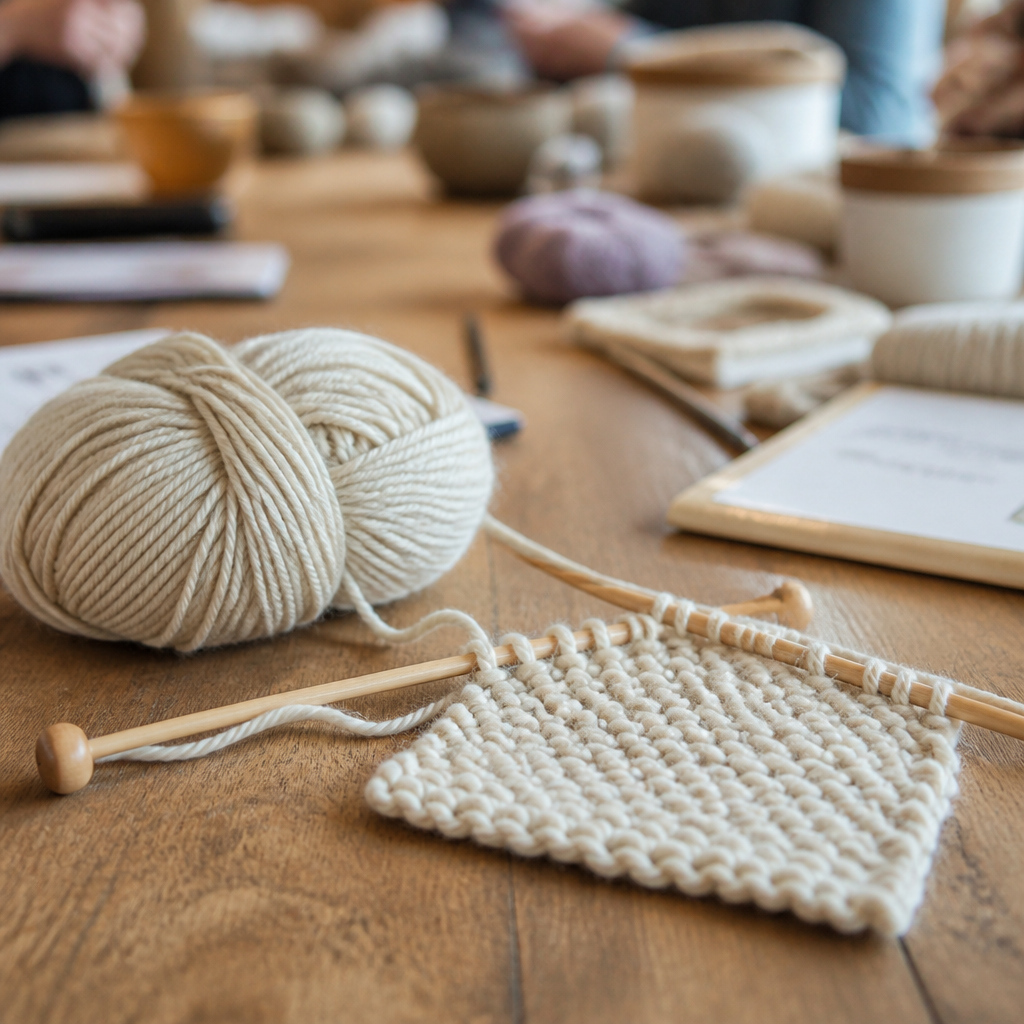
A swatch, not an object. Expect a crooked rectangle of garter stitch, tight at the start, looser at the top, with a couple of stitches more than you cast on. That is the normal and expected result of a first class, and anybody who tells you otherwise is selling something.
What actually goes home with you is the sequence: needle in, yarn around, pull through, slide off. Once those four moves are automatic, everything else in knitting is a variation on them.
What to bring
Many classes provide materials. When they do not, the list is short and the choices matter:
- Smooth, plied, pale, medium weight yarn, ideally wool or a wool blend, about 100 g.
- Needles of 5 to 5.5 mm (US 8 to 9), in wood or bamboo rather than metal, because they grip.
- Small scissors and a blunt tapestry needle.
- Reading glasses if you use them, and a bag with a flat bottom.
Pale yarn is not a style preference: you cannot see the structure of a stitch in a dark color, and a beginner needs to see it constantly. The reasoning behind each of those four adjectives is set out in the entry on choosing a first yarn.
The two ways of holding the yarn
English style, sometimes called throwing, carries the yarn in the right hand and wraps it around the needle. Continental style, sometimes called picking, holds the yarn in the left hand and scoops it. Neither is better. Continental is often quicker for plain knitting and familiar to anyone who crochets; English gives some people more control over tension.
A good teacher demonstrates both and lets you keep whichever your hands settle on. If you are left-handed, note that both hands work in either style; learning the standard hold is usually simpler in the long run, because every written pattern, video and helpful neighbour assumes it.
The three errors every teacher fixes in the first hour
- Stitches multiplying
- The working yarn sits in front of the needle instead of behind it, travels over the top on its way to the next stitch and becomes an extra loop. Cure: before every knit stitch, check that the yarn is behind the work.
- Splitting the yarn
- The needle tip goes through the plies of the strand instead of into the loop, leaving a fuzzy half-stitch. Cure: slow the entry of the needle, and use plied yarn rather than a single.
- Twisted stitches
- The yarn was wrapped the wrong way round, so the loop sits backwards on the needle and the fabric looks crossed and tight. Cure: check that the right leg of every loop is in front of the needle.
Tension, and what nobody says out loud
The first two inches of anybody's knitting are tight, then loose, then tight again. Tension settles after a few hundred stitches, not a few dozen, and it settles by itself. It is a matter of repetition rather than talent, and a wash and a flat dry hide a surprising amount of what is left.
The corollary matters for a first project: do not judge your knitting until you have made a few hundred stitches of it, and do not start a gauge-critical garment in week one.
Questions worth asking before booking
- Are materials included, or is there a list to buy from?
- How many people will be in the room?
- Is it one session or a series, and does the series build on itself?
- Do we make a swatch or a small project?
- Is there a drop-in group afterwards where questions can be asked?
That last one is worth more than the class itself. Most people learn the movements in one evening and then get stuck, once, on something that takes another knitter thirty seconds to spot.
Learning without a class
Video is an excellent substitute for demonstration and a poor substitute for correction. If no class is available, work in the same order a class would use: cast on, knit, bind off, then purl. Make a garter stitch square and then a seed stitch one before attempting anything shaped, and keep a crochet hook nearby for the first dropped stitch, which is coming.