Entry of
Teaching a child to knit: what works, and at what age
The hard part of teaching a child to knit is not the stitch. It is casting on, counting, and stopping while they still want to carry on.
Children learn the movements faster than adults and lose patience faster too. Almost every decision below is aimed at the same thing: making the work visibly grow before the interest runs out.
Readiness is not an age
Three abilities matter more than a birthday: holding two objects and coordinating them, tolerating a repeated movement, and accepting that a result appears slowly. Children commonly manage finger knitting from around five and needles from around seven, but the spread is enormous, and pushing a child who is not ready usually costs a year of willingness.
Useful signs: they can tie a lace or thread beads, they can follow a two-step instruction, and they have asked to try. The last one is the strongest.
Start without needles
Finger knitting, arm knitting and a French knitting spool all teach the same idea, that a loop pulled through a loop makes fabric, with none of the coordination load. A child who has made a two metre finger-knitted cord understands what the needles are for before touching them.
Materials that make it possible
- Thick, smooth, pale yarn, aran or bulky, in wool. Wool grips itself, so stitches stay on the needle. Acrylic slides.
- Short needles, 18 to 25 cm (7 to 10 in). Long ones hit the table, the sofa and the child's arms.
- Wood or bamboo, never slick metal, and blunt tips.
- A tapestry needle and small scissors, kept by the adult.
What to teach, in order
- Cast on for them for the first several projects. Casting on is the least intuitive movement in knitting and it has almost nothing in common with knitting itself.
- Garter stitch only. Knit every row. No purl, no right side and wrong side, no counting rows.
- Keep rows short, 15 to 20 stitches, so that a row takes a minute or two and the work visibly grows in a sitting.
- Bind off for them at the end, or teach it when they ask for it, which they will once something needs to come off the needles.
How to sit
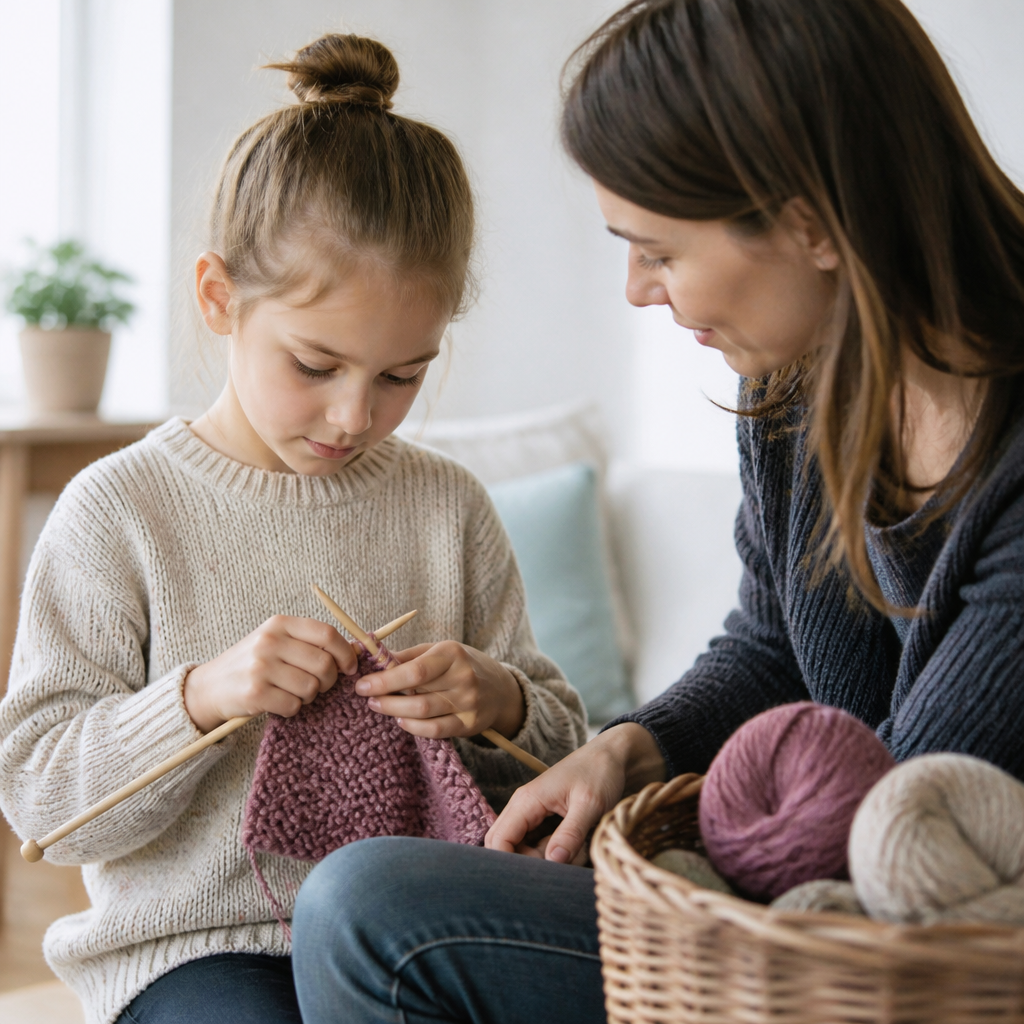
Sit beside the child, on the same side, so that your hands move the same way as theirs. Sitting opposite mirrors everything and is the single most common reason a lesson goes wrong. For the first attempts, sit slightly behind and put your hands over theirs, then withdraw one hand, then the other.
The rhyme, and why it works
In through the front door, run once round the back, out through the window, off jumps Jack. Four movements, four phrases, said aloud together until the hands do it without the words. It converts an abstract sequence into a rhythm, and rhythm is what children learn fastest.
The two frustrations to head off
- Stitches multiplying
- Caused by the yarn sitting in front of the needle, or by knitting twice into the same stitch. Count together at the end of every row for the first few sessions. If the count has grown, take the row back yourself without ceremony and hand the work back.
- Dropped stitches
- Inevitable. Fix them quietly and quickly with a crochet hook, the way described in the entry on dropped stitches, and do not turn the repair into a lesson. There is time for that later.
Session length and expectations
Ten to twenty minutes. Stop while they still want to continue, every time. A child who is made to finish a row they have lost interest in learns that knitting is a chore, and that lesson sticks harder than the stitch.
Uneven tension is not a problem to be corrected. It is what a first square looks like, at any age, and it evens out with hundreds of stitches rather than with instruction.
First projects that end
- A scarf or blanket for a doll or a soft toy: 20 stitches, any length they like, finished when they say so.
- A phone or tablet pouch: a rectangle folded and sewn up the sides by an adult.
- A coaster or a bookmark, which takes one sitting.
- A garter square for a group blanket, which turns slow work into a shared object.
Left-handed children
Both hands work in knitting, and neither is the leading hand in any simple sense. Teaching the standard hold is usually kinder in the long run, because every pattern, video and helpful relative assumes it. If it plainly is not working after a few sessions, mirror everything and move on: a mirrored knitter can read any pattern by swapping left for right.