Entry of
A walk down the yarn aisle: how a yarn shop is arranged
Yarn shops are arranged on a logic that is obvious once you know it and baffling until then. It takes about a paragraph to explain.
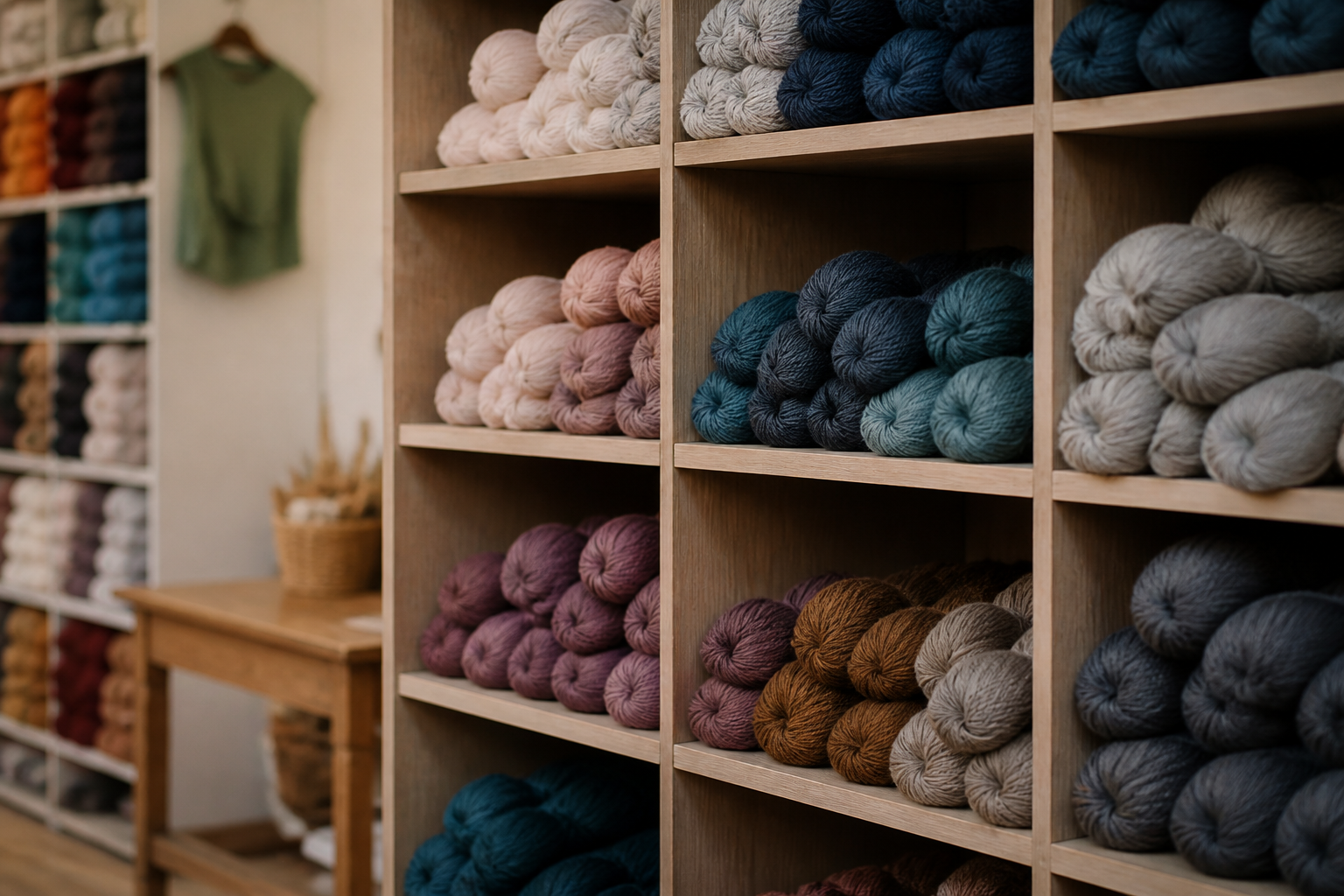
A wall of yarn is not sorted by colour, however much it looks like it. It is sorted by thickness, then by brand, then by shade, and that order is what makes a shop navigable in thirty seconds instead of half an hour.
The shelves run by weight
Fine yarns at one end, thick at the other: lace and fingering, then sport and DK, then worsted, then bulky. Within each band the brands are grouped, and within each brand the colours run together.
So the first question is never which colour, it is which weight. Once you know that a pattern wants category 4, an entire wall reduces to two shelves. The weight categories and their gauge ranges are set out in the entry on reading a yarn label.
Balls, skeins, hanks and cakes
- Ball
- Wound into a round shape, usually pulled from the outside. It rolls; keep it in a bag or a bowl.
- Skein
- The oblong machine-wound bundle most commercial yarn comes in. It is meant to be pulled from the centre, and the first tug produces a tangle called yarn barf. Pull it out, wind it round the outside, and carry on.
- Hank
- A large loop of yarn twisted on itself, which is how most hand-dyed and many luxury yarns are sold. It must be wound into a ball before use. Knitting straight from a hank produces a knot that ends the evening.
- Cake
- Flat-topped, wound on a machine, pulls from the centre and does not roll. What a hank becomes after winding.
Most shops will wind a hank at the counter on a swift and a ball winder, usually free with a purchase. Ask before leaving, because doing it at home over the back of a chair takes half an hour and a second pair of hands.
The notions wall, and what is actually needed
- From day one: a blunt tapestry needle, small scissors, a tape measure, and a few locking stitch markers.
- Soon after: a needle gauge with a ruler window, which both measures four inches of stitches and identifies unlabelled needles; a row counter; a ball of smooth waste yarn for holders and lifelines.
- Later, if the projects call for it: a cable needle, blocking mats and pins, and a stitch dictionary.
Almost everything else on that wall is a convenience. Waste yarn does the job of most stitch holders, and a bent paper clip does the job of a locking marker in an emergency.
Substituting one yarn for another
Patterns name a yarn; shops rarely have that exact one. Match three things, in this order:
- Gauge. The stitches per four inches on the band should match the pattern's gauge. This is the only requirement that cannot be negotiated.
- Total yardage. Not grams and not the number of balls: yards. Divide the pattern's total by the yardage of one ball and round up.
- Fiber behaviour. A pattern that relies on blocking to open out needs a fiber that answers to water. Swapping wool for acrylic changes the finished garment even when the gauge matches exactly.
The brand is irrelevant, and so is the name of the shade. Both are marketing.
Sale bins and single balls
Discounted single balls are usually the ends of dye lots or discontinued colours. That makes them excellent for hats, toys, swatches and stripes, and unsuitable for anything that needs more than one ball of the same colour. The reason is set out in the section on dye lots in the yarn label entry: two balls of the same shade from different lots can knit up as a visible band.
Touching the yarn properly
- Press it against the inside of the wrist or the side of the neck, not the palm. Palms are among the least sensitive skin on the body, and a scarf will sit at the neck.
- Untwist a short length to count the plies and see how tightly they are spun. Loose singles split; firm plies do not.
- Pull a length gently. Yarn that stretches and springs back is elastic and will hold its shape; yarn that stretches and stays long will grow in the garment.
- Rub a few inches between your fingers. If it pills there, it will pill on a sleeve.
Worth asking at the counter
- How much of this yarn does my pattern need, in balls?
- Are these all the same dye lot?
- Can this hank be wound?
- What is the policy on returning unwound balls if I buy one too many?
- Is there a group or a class here, and when?
That last question is the one that turns a shop into a resource. Most of the knitting knowledge in any town is in the heads of the people who sit around its tables, and it is given away free.
Buying online instead
The same three checks apply, in the same order, and two more are worth adding: buy one ball and swatch it before committing to a sweater's worth, and treat photographed colours as approximate, because no two screens agree. A listing that does not state the yardage and the gauge is not giving you enough to decide.